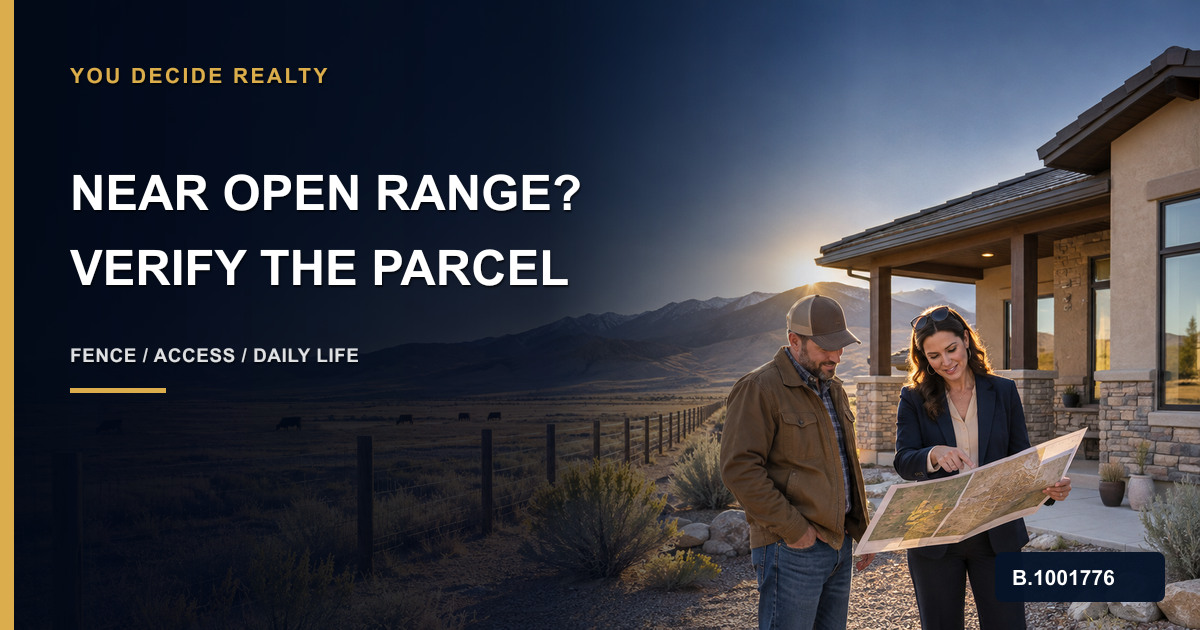
Buying a house near open range in Nevada begins with the exact parcel, not a rural-looking photo. NRS 113.065 requires a separate written disclosure before the purchaser signs a sales agreement when a home or improved lot is adjacent to open range. The disclosure addresses roaming livestock and possible county or state right-of-way claims. Confirm whether the law applies, obtain the signed Form 551, and investigate the fence, access, insurance, animals, roads, utilities, and daily operations with qualified professionals.
Confirm actual adjacency and the disclosure before signing
Use the assessor parcel, survey, title material, maps, and public-land or county records to determine what touches the parcel. NRS 113.065 places the disclosure before the sales agreement is signed. Verify the correct parcel or home ID, buyer receipt date, signatures, notarization and recording plan with the transaction team; a listing description is not proof.
Read the livestock language literally
Nevada defines open range as unenclosed land outside cities and towns where cattle, sheep or other domestic animals are grazed or permitted to roam. Form 551 warns that livestock may enter unless a fence prevents entry and that harming livestock is unlawful. Ask counsel and local authorities how the current law applies to the exact facts rather than inventing a general rule.
Inspect the fence as a working system
Document fence location, ownership evidence, type, gates, cattle guards, condition, gaps, drainage crossings, repair history, access for maintenance, and whether planned improvements require approval. A visible fence may not be on the boundary or suited to the animals involved. Use surveyors, fence contractors, insurers, title professionals and counsel as appropriate.
Investigate rights-of-way and everyday access
The statutory disclosure also warns of possible county or state R.S. 2477 or other rights-of-way that may be unrecorded, undocumented or unsurveyed and used by miners, ranchers, hunters or others. Review title, survey, county and agency records, road maintenance, gates, emergency access, deliveries, utilities and seasonal conditions.
Price the operating reality without guessing
Ask about insurance, animals and pets, trash, water and septic, wildfire preparation, dust, noise, road condition, school or work travel, deliveries, vendors, security and emergency response. Separate confirmed facts from estimates, and keep a written list of unresolved items, responsible professionals, decision dates and contract options.
FAQ
What does open range mean in Nevada?
NRS 568.355 defines it as unenclosed land outside cities and towns where cattle, sheep or other domestic animals are grazed or permitted to roam by custom, license, lease or permit.
When is Nevada Form 551 due?
NRS 113.065 requires the separate written disclosure before the purchaser signs a sales agreement for a home or improved lot adjacent to open range. Confirm applicability and execution with the transaction team.
Does a fence solve every open-range issue?
No. Fence location, ownership, condition, suitability, maintenance, rights-of-way, access and the actual legal facts all require separate verification.
Primary sources and limits
- Nevada Legislature, NRS 113.065 open-range disclosure
- Nevada Legislature, NRS 568.355 open-range definition
- Nevada Real Estate Division, Disclosure Forms
- Nevada Real Estate Division, Form 551 Open Range Disclosure
- Nevada Real Estate Division, 2026 Residential Disclosure Guide
- University of Nevada, Reno Extension, Nevada Open Range Law
- HUD, Fair Housing Act overview
Educational information only. Open-range status, adjacency, grazing, livestock, fencing, boundaries, rights-of-way, access, roads, land use, utilities, water, septic, insurance, wildfire planning, animal response, contracts, referral scope, and Section 1031 treatment are parcel-, jurisdiction-, party-, contract-, and fact-specific. A rural appearance, map, disclosure, fence, title summary, sent file, or accepted introduction does not establish open-range status, boundary, access right, fence duty, legal remedy, permitted use, insurability, financing, investment suitability, exchange qualification, or completed referral. Verify the current law, parcel, city or town boundary, assessor and survey records, title, land status, grazing facts, disclosure, recorded documents, fence and road condition, agency and county records, insurer and lender requirements, taxpayer, QI agreement, federal dates, license, scope, and completed status with the broker, surveyor, title and settlement provider, fence contractor, planner, county or agency, insurer, lender, qualified intermediary, CPA, attorney, regulator, and other qualified professionals. No individualized legal, tax, lending, insurance, securities, appraisal, engineering, land-use, fair-housing, brokerage, or investment advice is provided.
Related: checking Nevada property records and disclosures, reviewing a property survey and boundaries, contact You Decide Realty.