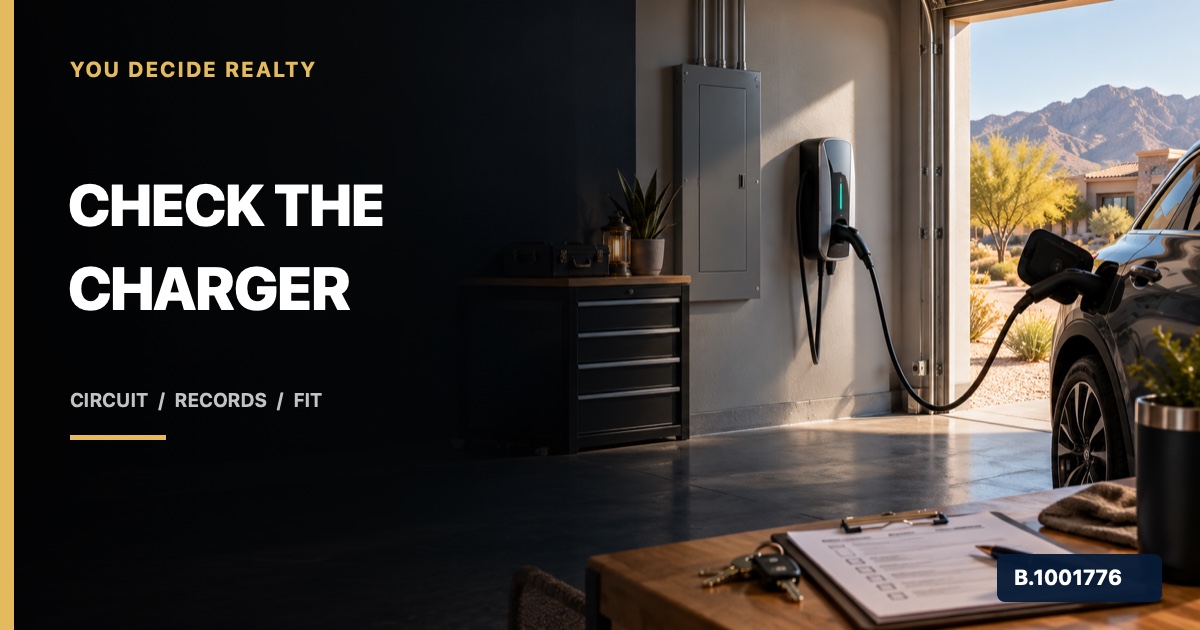
Buying a house with an EV charger starts with one practical rule: a charger on the wall is not proof that the setup is compatible, permitted, undamaged, or adequate for your routine. Clark County fire-safety guidance says to use listed equipment, avoid extension cords, inspect chargers and cords for damage, and have a qualified electrician confirm that the electrical system can handle charging. Verify the actual equipment, circuit, records, parking reach, vehicle connection, and transfer terms before treating the feature as ready to use.
Identify what is actually included
Record the charger manufacturer and model, connector, serial number, mounting location, cable length, accessories, account or app requirements, and whether the seller intends to leave every component. Confirm transfer terms in the transaction documents. A wall unit, receptacle, adapter, subscription, and installation warranty may have different owners or transfer rules.
Have the electrical setup evaluated
Ask a qualified electrician to evaluate the panel capacity, breaker and circuit, receptacle or hardwired connection, grounding and GFCI protection where applicable, visible condition, and installation against current requirements for the property. DOE notes that Level 2 equipment uses 240 volts and that homes may need added capacity, a new circuit, and local permits. An empty breaker slot does not answer those questions.
Match the charger to the household routine
Compare the vehicle connector, manufacturer guidance, expected daily miles, usual parking position, cable reach, overnight dwell time, and backup public-charging plan. A safe Level 1 setup may fit one household while another needs a properly installed Level 2 system. Do not turn a generic charging-speed estimate into a promise for a particular vehicle or home.
Example: the charger works, but the records are incomplete
A buyer sees a Level 2 wall unit in the garage. The seller confirms it stays, but cannot locate the permit or installer invoice. The buyer records the model, asks the local authority about available records, has the electrical setup evaluated, confirms connector compatibility, and decides based on written findings rather than the listing photo.
FAQ
Does an installed EV charger automatically add value to a house?
No automatic value conclusion follows from the charger alone. Compatibility, installation quality, records, condition, transfer terms, parking access, buyer demand, and the property as a whole all matter.
Can I use an extension cord with a home EV charger?
Clark County fire-safety guidance says not to use extension cords with the charger. Follow the vehicle and charging-equipment manufacturers’ instructions and use a qualified electrician for the property setup.
Should I test the charger before closing?
Coordinate any test with the seller, contract, inspector, electrician, and equipment instructions. A successful charging session can confirm limited function at that moment, but it does not replace electrical, permit, condition, or transfer review.
Primary sources and limits
- Clark County Fire Department, Electric Vehicles: Safe Charging at Home
- U.S. Department of Energy, Charging Electric Vehicles at Home
- U.S. Department of Energy, Electric Vehicles for Consumers
- U.S. Fire Administration, Lithium-Ion Batteries
General education only. A listing photo, wall charger, receptacle, permit search, charging session, equipment label, lease note, or exchange structure does not by itself establish compatibility, electrical capacity, code compliance, permission, safety, ownership, value, insurance treatment, or tax outcome. Confirm the exact property, equipment, circuit, panel and service capacity, permits, inspections, parking, permissions, transfer terms, manufacturer instructions, insurance questions, transaction deadlines, and operating implications with the seller, landlord, HOA, utility, vehicle and equipment manufacturers, qualified electrician, responsible public office, insurer, lender, attorney, CPA, and qualified intermediary as appropriate. No individualized legal, tax, lending, securities, insurance, privacy, compliance, or investment advice is provided.
Related: how to check permits before buying, Nevada buyer services, contact You Decide Realty.