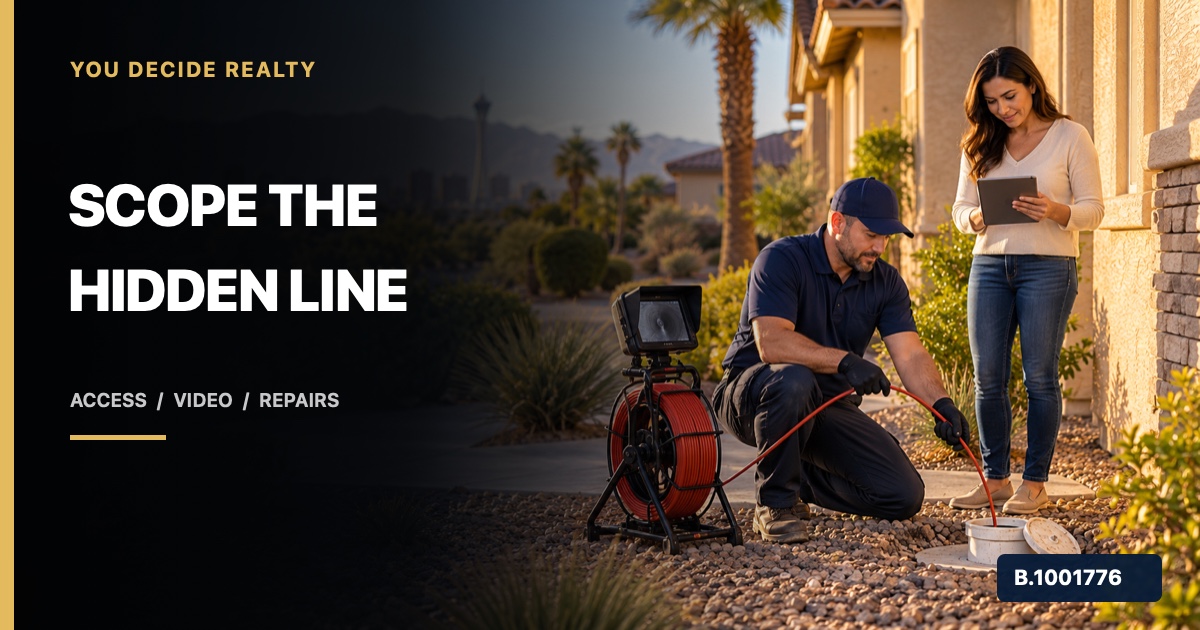
A sewer scope inspection when buying a house can document conditions inside the private sewer lateral that are not visible during an ordinary walkthrough. In unincorporated Clark County and the City of Las Vegas, official guidance places cleaning, repair, and replacement of the private lateral on the property owner. The buyer decision is not simply whether a camera entered a pipe. It is whether the correct line was inspected, the access and distance were documented, the video and written findings are usable, and every unresolved condition has a qualified owner before closing.
Confirm the system and the responsible line
First confirm that the property connects to a public sewer rather than an individual septic system. Identify the service provider or jurisdiction and ask where the private lateral begins and connects to the public main. Clark County Water Reclamation District defines a lateral as privately owned horizontal piping that carries wastewater from the building drain toward the public or private collection system. Do not assume the curb, sidewalk, property line, or street automatically changes responsibility; verify the address-specific rule and title or easement question with the responsible parties.
Define the sewer-scope assignment in writing
Ask the qualified provider what entry point will be used, how far the camera is expected to travel, whether the full private lateral can be observed, and what will be delivered. A useful package can include the dated video, a written report, distance markers, line material when supportable, access limitations, observed defects or obstructions, and recommended next review. A general home inspection may review readily accessible waste and drain components, but its exact scope should not be assumed to include a camera inspection of a buried line.
Treat limited access as a finding, not a clean bill
A missing, buried, damaged, inaccessible, or unsafe cleanout can prevent a complete scope. So can standing water, blockage, bends, line configuration, or equipment limits. Record where the camera stopped and why. An incomplete view does not prove that the unseen section is clear, damaged, or problem-free. It creates a defined question for the plumber, inspector, seller, jurisdiction, contractor, attorney, or other qualified reviewer.
Reconcile the video with the property file
Request available backup history, cleaning records, prior videos, repair invoices, permits or approvals when applicable, contractor identity, warranties, insurance information, and any shared-line or association documents. Match every record to the correct address and line segment. Verify a proposed repair contractor through the Nevada State Contractors Board and confirm the contractor classification and scope rather than relying on a familiar company name.
Turn findings into a written closing decision
If the report identifies roots, offsets, breaks, corrosion, bellies, obstructions, standing water, or an unclear connection, obtain the right specialist interpretation and written repair or further-evaluation scope. Assign access, utility locating, excavation questions, permits, estimates, contract response, reinspections, documentation, and deadline ownership. The article cannot decide whether a buyer should proceed; the complete file helps the buyer make that decision with the contract team.
Example: the camera stops before the street
The provider enters through an exterior cleanout but cannot pass an obstruction halfway to the apparent connection. The buyer preserves the video and distance, asks for the line route and available service history, obtains qualified follow-up, verifies who is responsible for the affected segment, and documents the contract response before the due-diligence deadline. The words “scope attempted” are not treated as proof of a clear lateral.
FAQ
What does a sewer scope inspection show?
A camera inspection can document the observable interior of the accessed line, including the route, distance, material clues, obstructions, roots, offsets, damage, standing water, and access limits. It does not by itself prove ownership, code compliance, future performance, or repair cost.
Is a sewer scope part of a Nevada home inspection?
Do not assume it is. Nevada inspection standards address readily accessible plumbing and functional flow, while a buried-line camera inspection has its own access, equipment, provider, and reporting scope. Confirm in writing what your inspector or plumber will perform.
Who is responsible for the sewer lateral in Las Vegas?
Clark County Water Reclamation District and the City of Las Vegas state that the private lateral serving the property is the owner’s responsibility. Verify the exact address, jurisdiction, connection, easements, shared facilities, association documents, and contract terms before assigning responsibility.
Primary sources and limits
- Clark County Water Reclamation District, Report a Sewer Problem
- Clark County Water Reclamation District, Definition of Lateral
- City of Las Vegas, Sewer Back Up Issues
- Nevada Administrative Code Chapter 645D, Inspectors of Structures
- Nevada Real Estate Division, Active Licensee Lists
- Nevada State Contractors Board, License Search
General education only. A listing, seller statement, disclosure, invoice, service call, cleanout, camera run, video, report, utility mark, permit record, warranty, contractor proposal, insurance record, or exchange structure does not by itself establish the full line route, ownership, condition, capacity, code compliance, repair quality, future performance, cost, coverage, lender acceptance, or investment result. Confirm the exact property, wastewater provider, private lateral, connection, easement, cleanouts, access, line segments, scope distance, limitations, backup history, repairs, shared facilities, association terms, permits or approvals, contractor licensing, estimates, contract response, reinspection, and closeout evidence with the responsible utility, seller, owner, tenant, HOA, inspector, qualified plumber or contractor, title and escrow professionals, lender, insurer, attorney, CPA, and qualified intermediary as appropriate. No individualized legal, tax, contract, engineering, environmental, lending, insurance, privacy, compliance, securities, or investment advice is provided.
Related: separating public-sewer and septic diligence, checking repair and permit records, contact You Decide Realty.